Thailand eSIM vs Physical SIM (2026): Which to Buy?
Published
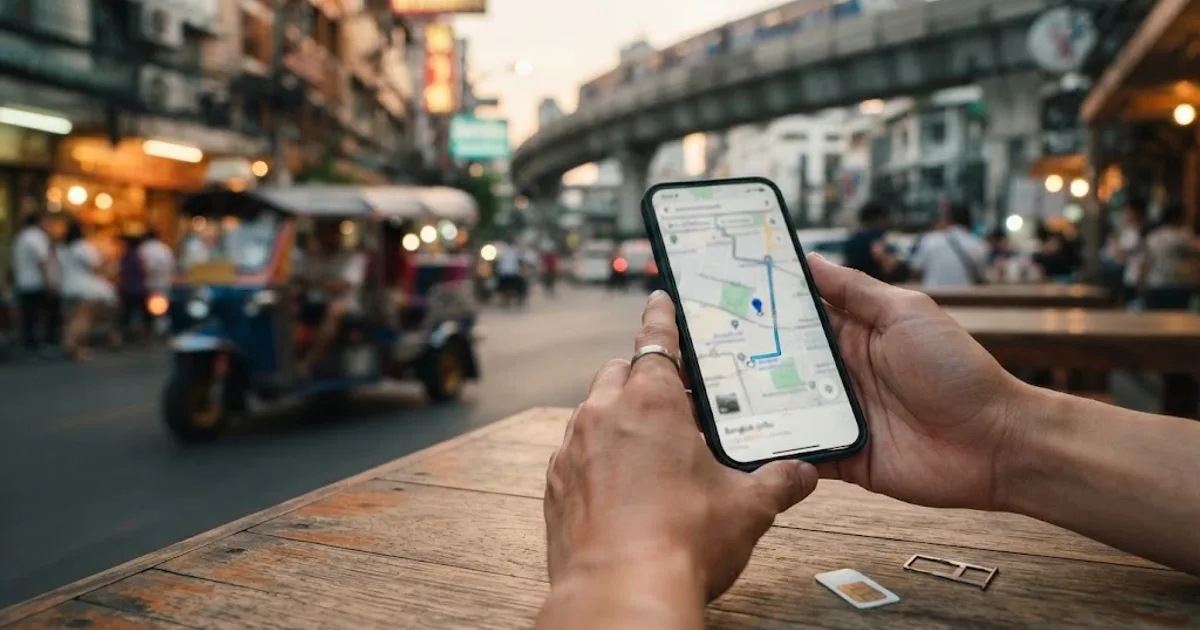
Short answer: for most travellers with a modern, unlocked phone, an eSIM is easier. For an older phone, two phones, or a long stay on a budget, a physical SIM can be the better choice. What it is not is a coverage question. An eSIM and a physical SIM from the same operator use the same network.
The comparison that actually matters in Thailand is a different one: a Thai operator SIM or eSIM (AIS, True, dtac) versus an international travel eSIM. That is where the Thai number, registration, price and throttling differences come from, so this page compares all three products.
Prices and rules in this guide were checked on 6 October 2026. Operator tariffs change, so confirm on the operator’s page before you buy.
Three products, not two
| Thai physical SIM | Thai operator eSIM | International travel eSIM | |
|---|---|---|---|
| Network | AIS, True or dtac | AIS, True or dtac | Roaming or resold access; the Thai network varies by provider |
| Thai phone number | Usually yes | Yes | Often no (data-only) |
| Passport registration | Yes, at the counter | Yes, through the operator’s process | Product-dependent; not done by you at a counter |
| Buy before you fly | Rarely | Yes | Yes |
| Airport queue | Usually | No | No |
| Keep your home SIM active | Only with a dual-SIM phone | Yes | Yes |
| Needs an eSIM-compatible, unlocked phone | No (unlocked only) | Yes | Yes |
| Move to another phone | Easy, take the card | Operator-supported transfer | Provider rules |
| Calls and SMS | Yes | Yes | Often data only |
Evidence: official operator pages (AIS, True) for the structure of the products; the table is our synthesis, not a measured comparison.
Does eSIM or physical SIM have better coverage?
No. If you buy an AIS eSIM and an AIS physical SIM, both ride the AIS network. We found no controlled study showing a speed or coverage advantage that comes from the SIM format alone. Problems that look like “eSIM is worse” are usually installation, activation, a wrong data-line setting or the wrong APN, not signal quality.
The network does matter, and independent measurement exists for it.
Independent measurement (Opensignal, June 2025 Thailand report):
| Metric | Result |
|---|---|
| Consistent quality | AIS 71.5%, dtac 68.0%, TrueMove H 61.3% |
| Reliability | dtac led (883 on a 100-1,000 scale) |
| 5G download speed | AIS 105.3 Mbps |
| Coverage experience | AIS led |
AIS won most categories, but dtac won reliability, so there is no single best network for every use. These figures measure real users’ network experience in 2025, not an eSIM-versus-SIM test, and True has since merged its dtac and TrueMove H networks.
If your route is deep in the north, the national parks or remote islands, AIS has the strongest independent evidence. For Bangkok, Phuket, Chiang Mai and the main tourist areas, all the major networks perform well.
The biggest practical difference: you land connected
The strongest argument for an eSIM is simple. You install it before departure and your phone is online when you land. That matters for the things you need in the first hour: Google Maps, Grab or Bolt, your hotel’s address, translation and messaging.
With a physical SIM the sequence is: clear immigration, collect your bags, find the counter, queue, hand over your passport, register, have the SIM fitted, activate, test. With an eSIM bought and installed in advance it is: land, switch the line on, connect.
With a dual-SIM phone you can keep your home SIM active for SMS and bank one-time codes while the eSIM carries data. That setup is one of the most consistently reported benefits among travellers, and Lonely Planet makes the same point.
The Thai number: where physical SIMs and operator eSIMs win
A conventional Thai tourist SIM gives you a Thai mobile number with calls and SMS. So does a Thai operator eSIM. Many international travel eSIMs, however, are data-only.
That matters if you need to call a restaurant or tour operator, receive an SMS from a local service, register for a Thai app, or use a Thai number for delivery services. For a short trip using only maps, Grab and WhatsApp, a number is not needed.
A common travel-site claim says “eSIMs don’t have Thai numbers”. That is wrong for operator eSIMs. The accurate version is: many international travel eSIMs are data-only; Thai operator eSIMs can give you a normal Thai number.
Registration: eSIM does not bypass Thai rules
This is the point most “eSIM vs SIM” articles get wrong.
- Thai law applies to SIMs and eSIMs alike. The NBTC (Thailand’s telecoms regulator) has stated that its measures for foreign users cover both SIM cards and eSIMs.
- Passport and live face check. Since August 2025, new registrations and same-number replacements involve liveness detection, a real-time face check.
- Limits for foreigners. Reporting and operator terms describe a limit of three SIMs per person per operator or brand, and tourist SIMs have a maximum validity. AIS and True/dtac both describe re-identifying with your passport to continue use past the tourist period (60 days).
- Two 60-day rules are often confused. One is an activation deadline after registration; the other is the maximum tourist-SIM service period. Topping up credit alone does not extend a tourist SIM.
Official source / legal commentary: the May 2026 amendment is described by law firm Tilleke & Gibbins; we did not obtain the original NBTC notification.
Not resolved: the law firm’s analysis says foreign users must register in person at a branch or authorised dealer, yet AIS’s own eSIM page says visitors arriving from abroad can buy a local eSIM online and describes online verification. We could not reconcile the two. Treat “I can complete a Thai operator eSIM entirely online as a foreign visitor” as something to confirm with the operator on the day.
So do not read “eSIM” as “no registration”. It is generally true only for many international travel eSIMs, not for Thai operator eSIMs.
Price: eSIM is not automatically dearer, and physical is not automatically cheaper
Price snapshot, 6 October 2026, operator pages. Official tourist tariffs, which are the same whether you take the SIM or the eSIM:
| Operator | Plan | Price |
|---|---|---|
| AIS tourist | 5 days | THB 399 |
| AIS tourist | 8 days | THB 499 |
| AIS tourist | 15 days | THB 699 |
| AIS tourist | 30 days | THB 1,199 |
| AIS tourist | 60 days | THB 1,599 |
| True/dtac Infinite | 8 days | THB 499 (the True FAQ still shows 449) |
| True/dtac Infinite | 15 days | THB 699 |
| True/dtac Infinite | 30 days | THB 1,199 |
| dtac Happy Tourist | 8 days, 15 GB high-speed | THB 299 |
| dtac Happy Tourist | 15 days, 30 GB high-speed | THB 599 |
AIS and True/dtac sell the same tourist packages as eSIM and physical SIM, so “physical is cheap, eSIM is expensive” is not true for operator products. The cheaper deals come from buying an ordinary prepaid SIM away from the airport (see below), not from the SIM format.
Our plans, for comparison. Our Thailand eSIM runs on TrueMove H and is delivered by email:
| Plan | Data | Price |
|---|---|---|
| 7 days | Unlimited, up to 1 Mbps | $8.90 |
| 8 days | Unlimited | $18.90 |
| 10 days | Unlimited, up to 348 kbps | $11.90 |
| 15 days | Unlimited | $37.90 |
| 30 days | Unlimited | $47.90 |
The 7- and 10-day plans are lower-speed unlimited plans, not full-speed. The 8-, 15- and 30-day plans are full speed. We charge more than the operators’ own 30-day tourist price for 30 days; what you pay for is delivery before you fly and no counter or passport step on your side.
Airport, city shop or 7-Eleven?
| Where | For | Against |
|---|---|---|
| Airport counter (AIS, True, dtac at Suvarnabhumi, Don Mueang, Phuket and others) | Available on arrival, staff register and fit it | Queue, tourist packages dominate, can cost more |
| Official operator shop in town | Wider package choice, support, can change packages | You need to get there first |
| 7-Eleven and local retailers | Everywhere, can be cheap | Packages offered to foreigners vary by branch, English may be limited |
| eSIM before you fly | Online on landing, no queue, no card to swap | Phone must support it; an international eSIM may be data-only; an operator eSIM still has registration |
User report (labelled, not measured): a January 2026 traveller thread said some tourist-area 7-Elevens would only sell tourist SIMs, while less touristy branches sold ordinary prepaid SIMs after passport registration. A February 2026 thread reported a local 7-Eleven/AIS option cheaper than tourist eSIMs, and another traveller reported 100 GB of 5G for THB 399 at an official AIS shop. Treat these as anecdotes, not rules. We would not write “you can always buy a cheap SIM at 7-Eleven”.
The same reports give a useful pattern: for 2 to 7 days the airport premium is small and the convenience is worth it; for longer stays, buy a basic package and top up, or move to a local plan.
”Unlimited” does not mean the same thing everywhere
Thai operator tourist plans advertise unlimited 4G/5G at maximum speed. Some international eSIMs advertise “unlimited” but apply a daily threshold and then slow you down. An August 2026 comparison by Traviva listed examples such as 3 GB a day then 1 Mbps for one provider and 2 GB a day then 512 kbps for another.
Also read the fine print on the operators’ own plans: dtac’s Happy Tourist plans say “unlimited internet” next to a finite high-speed allowance (15 GB or 30 GB). That is not unlimited full-speed data.
Compare four things instead of the word “unlimited”: the high-speed allowance, the speed after it, the validity, and whether hotspot is allowed.
Where a physical SIM is the better choice
- Your phone has no eSIM support, or is carrier-locked. A physical SIM works in nearly any unlocked phone.
- You carry two phones. A physical SIM moves easily to a second device, which suits using one phone as a hotspot. Moving an eSIM means a new activation or an operator-supported transfer, and AIS’s self-service transfer is limited to devices of the same brand.
- You are staying one to two months and want a Thai number, local calling and the cheapest per-GB plan.
- You want in-person help. A shop can fix a problem on the spot.
Where an eSIM is the better choice
- Short trip, modern phone. The convenience is large and the price difference is small.
- Dual-SIM setup. Keep your home SIM for calls, SMS and bank codes while the eSIM carries data.
- Land connected. Maps, a ride and messaging work before you reach baggage claim.
- You do not want to hand over a passport and face scan at a counter after a long flight. With our eSIM there is no KYC at all: no passport, no face scan, no counter.
Which one for which traveller
| Traveller | Our pick |
|---|---|
| 3-7 day tourist, modern phone | eSIM (travel or operator) |
| 7-14 days, data only | eSIM |
| 7-14 days, want a Thai number | Thai operator eSIM or SIM |
| 2-4 weeks | Operator eSIM or physical SIM |
| 1-2 months, digital nomad | Local Thai SIM or eSIM, a second network as backup |
| Deep rural Thailand or remote islands | AIS |
| Older or non-eSIM phone | Physical SIM |
| Two phones, one as a hotspot | Physical SIM |
A flexible approach many travellers report: use an eSIM for the first hour and the first days, then buy a local SIM later if you stay long enough to need a Thai number or cheaper data.
Our eSIM, and what it is not
Our Thailand eSIM is a data eSIM on TrueMove H, delivered by email and activated automatically when your phone connects in Thailand. Validity starts at first connection, so installing it before the flight costs you nothing. No KYC: no passport, no selfie, no counter and no registration for you. Install it and go.
What it is not: it is not a full Thai phone line. The +66 number receives calls and SMS for free, but you cannot make outgoing calls or texts. If you need to call local numbers, a Thai operator SIM or eSIM is the right product. For maps, Grab, messaging and browsing, data is enough. Compatible phones and the install steps are on each plan page, and our Thailand carriers comparison goes deeper on the three networks.
Going on to Vietnam or Cambodia? A regional eSIM can cover several countries on one balance, and for Laos see our Laos and Thailand guide.
How we checked this
- Operator pages: AIS tourist plan, eSIM and SIM activation; True tourist SIM; dtac Happy Tourist.
- Regulation: NBTC announcements, plus Tilleke & Gibbins’ May 2026 analysis of the amended notification and Nation Thailand’s August 2025 report on liveness detection.
- Independent measurement: Opensignal’s June 2025 Thailand mobile network experience report.
- Travel press: Lonely Planet’s Thailand connectivity guide.
- Traveller reports (labelled, not measured): threads on r/ThailandTourism between 2022 and 2026 about eSIM, 7-Eleven and airport SIMs. We used them to show what travellers report, not as price lists.
- Commercial comparisons (Traviva and similar) are used for plan structure only, not as independent evidence.
What we couldn’t verify
- Whether a foreign visitor can complete operator eSIM registration fully online under the May 2026 rules. Official operator pages and the legal commentary point in different directions.
- The original NBTC notification. We rely on a law firm’s description of it.
- A controlled test of eSIM versus physical SIM speed in Thailand. We found none, which is why we say the format does not change coverage rather than quoting a number.
- Opensignal’s August 2026 report, which we could not retrieve in full, so we use the accessible June 2025 figures.
- Airport prices. Counter prices at specific airports are travellers’ reports, not price-board photos.
The bottom line
Thailand’s real choice is not eSIM versus a plastic card. It is a Thai operator subscription (in either format) versus an international eSIM, and then convenience versus flexibility. If your phone supports eSIM and you want to land connected, take an eSIM. If you need a Thai number, calls or the cheapest long-stay data, take a Thai operator SIM or eSIM and expect passport registration. If your phone does not support eSIM, or you carry two phones, take a physical SIM.
Want to land connected? See the Thailand eSIM plans.
Frequently asked questions
Is an eSIM better than a physical SIM in Thailand? +
For most travellers with a modern unlocked phone, an eSIM is more convenient: you install it before you fly, keep your home SIM active and land connected. A physical SIM is better if your phone has no eSIM support, if you carry two phones, or if you want the cheapest local price on a long stay. Network quality is not a reason to choose either.
Do eSIMs work on the same network as physical SIMs in Thailand? +
If both come from the same operator (AIS, True or dtac), yes: an eSIM is a different way of delivering the same subscription, not a different radio network. What changes the experience is which network the eSIM uses and whether it is a local Thai subscription or an international roaming eSIM.
Do I need to register my passport for a Thai eSIM? +
For a Thai operator eSIM, plan on yes. Thai rules cover SIMs and eSIMs, and operators ask for a passport and a live face check. Our eSIM needs no KYC: no passport, no selfie, no counter and no registration step for you. The line is already registered by our supplier. Other international travel eSIMs vary by product.
Can an eSIM give me a Thai phone number? +
A Thai operator eSIM can, with normal calls and SMS. Many international travel eSIMs are data-only. Our Thailand eSIM carries a Thai +66 number that receives calls and SMS for free but cannot make outgoing calls or texts.
Is a physical SIM cheaper than an eSIM in Thailand? +
Not as a rule. AIS and True/dtac sell the same tourist packages as eSIM and physical SIM at the same published prices. Travellers report that ordinary prepaid SIMs from city shops or some 7-Eleven branches can cost less than airport tourist packages, but availability to foreigners varies by branch.
Can I buy a Thai SIM card at the airport? +
Yes. AIS, True and dtac all list counters at Suvarnabhumi, Don Mueang, Phuket and other airports. Expect a queue, passport registration and sometimes a higher price than in town. An eSIM installed before the flight avoids the queue.
Does 'unlimited' mean the same on every Thailand eSIM? +
No. Operator tourist plans advertise unlimited data at maximum speed, while some international eSIMs apply a daily high-speed allowance and then slow you to 1 Mbps or less. Compare the high-speed allowance, the throttled speed, the validity and whether hotspot is allowed, not the word 'unlimited'.
Which is best for deep rural Thailand or the islands? +
Opensignal's 2025 Thailand report put AIS ahead on coverage and consistent quality, so AIS has the strongest independent evidence for remote areas. That is a network choice, not an eSIM-versus-SIM choice: an AIS eSIM and an AIS physical SIM use the same network.
What if my phone does not support eSIM? +
Then a physical SIM is your only option. An eSIM also needs an unlocked phone; a carrier-locked phone will not accept a new eSIM profile. Check your phone's settings or your carrier before you buy.
Get connected for your trip
Unlimited data at up to 1Mbps
- Unlimited data at up to 1Mbps
- Automatic activation
- Free to receive calls & SMS
Automatic. Data works the moment the eSIM connects to TrueMove H. Nothing to dial, nothing to switch on.
QR emailed within minutes · Stripe secure checkout · No account needed
Thailand
Thailand · 8 days (Unlimited)
Unlimited data
- Unlimited data
- Automatic activation
- Free to receive calls & SMS
Automatic. Data works the moment the eSIM connects to TrueMove H. Nothing to dial, nothing to switch on.
QR emailed within minutes · Stripe secure checkout · No account needed
Unlimited data at up to 348kbps
- Unlimited data at up to 348kbps
- Free to receive calls & SMS
- Automatic activation
Automatic. Data works the moment the eSIM connects to TrueMove H. Nothing to dial, nothing to switch on.
QR emailed within minutes · Stripe secure checkout · No account needed