Vietnam eSIM vs Physical SIM (2026): Which to Buy?
Published
Short answer: for most travellers with a modern, unlocked phone, an eSIM is easier. For an older phone, a need to make local calls, or a stay of several months, a physical SIM can be the better choice. What it is not is a coverage question. An eSIM and a physical SIM from the same operator use the same network.
The comparison that decides your trip in Vietnam is the one hidden inside “physical SIM”: a walk-in SIM registered to you with your passport, versus a pre-activated SIM sold by a kiosk, versus an eSIM you install before you fly. Vietnam’s rules make that difference matter more here than in most countries.
Facts and prices in this guide were checked on 7 October 2026. Operator tariffs and rules change, so confirm on the operator’s page before you buy.
Three products, not two
| Physical SIM at an official store | Physical SIM from a kiosk or booth | eSIM | |
|---|---|---|---|
| Network | Viettel, MobiFone or VinaPhone | Carrier-branded, sometimes a reseller | Local profile on one of those networks, or an international eSIM that roams |
| Passport registration | Yes, in your name | Should be, but travellers report otherwise | Product-dependent; not done by you at a counter |
| Buy before you fly | No | No | Yes |
| Queue on arrival | Yes | Yes | No |
| Keep your home SIM active | Only with a dual-SIM phone | Only with a dual-SIM phone | Yes |
| Needs an unlocked, eSIM-capable phone | No | No | Yes |
| Vietnamese number | Yes | Yes | Some plans only |
| Move to another phone | Take the card, but see the face-check note below | Take the card | Provider rules |
Evidence: official operator pages (Viettel, MobiFone) for the structure of the products and for registration; the kiosk column is traveller reports, listed below. The table is our synthesis, not a measured comparison.
Does eSIM or physical SIM have better coverage?
Neither. Coverage follows the operator, not the SIM format. A Viettel eSIM and a Viettel physical SIM attach to the same Viettel radio network. If you want coverage detail, our Viettel vs VinaPhone vs MobiFone coverage guide compares the three networks, and our Ha Giang Loop and Sapa coverage guide covers the mountains.
The one real network difference is between a local profile and an international eSIM. A local eSIM attaches directly to the Vietnamese operator. Many international eSIMs reach Vietnam through a roaming agreement, which means data roaming usually has to be on, the Vietnamese operator is chosen for you, and travellers describe some of them as slower. That is a reason to check which kind of eSIM you are buying, not a reason to prefer a physical SIM.
Registration: the part that actually differs
A physical SIM in Vietnam is registered to you with your passport. That is the law, not a shop policy. Decree 163/2024/ND-CP, in force since 24 December 2024 and replacing Decree 49/2017, requires subscriber identification, and a foreign visitor registers with an original passport.
What the process looks like, per the official operators:
- Viettel’s tourist process asks for the passport, a photo of the passport, a live face photo and an email address.
- Face checks are getting stricter. A Viettel notice effective 15 June 2026 introduces mandatory face re-verification when a subscriber changes phone. It is aimed at SIMs registered in Vietnam, but it shows the direction: a SIM registered to you is increasingly tied to you.
- The SIM must belong to the person using it. Vietnam has been cleaning up wrongly registered SIMs, which is why a SIM registered to someone else is a real risk, not a technicality.
What our eSIM does differently. The line is pre-registered by our supplier, so there is no counter, passport, selfie or eKYC step on your side. We do not say that no identity check applies. The law requires subscriber registration, and it is met upstream, before you buy. If you want a line registered in your own name, buy a physical SIM from an official store.
What it costs
Price depends far more on who sells it than on the format. Treat these as reported prices, not a tariff.
- Airport booths. A Tripadvisor traveller in May 2026 reported 400,000 VND at an airport booth for what they understood to be a 30-day Viettel package, against 180,000 VND at an actual Viettel store for a comparable plan. Reports from Da Nang put airport SIMs at 350,000 to 400,000 VND. A traveller at Ho Chi Minh City photographed a board in 2026 showing Viettel 30 days at 300,000 VND and MobiFone packages at 250,000, 300,000 and 350,000 VND.
- Guides’ claim. Several guides say the airport costs 30 to 50% more than city shops. We could not trace this to a primary source, so treat it as a commonly repeated estimate.
- Our eSIM. Viettel: $9.90 for 7 days (35GB), $14.90 for 15 days (75GB), $19.90 for 30 days (150GB), 5GB a day. MobiFone: $7.90 for 5 days (30GB) and $10.90 for 10 days (50GB) with a +84 number, and $9.90 for 11 days (38GB) with 40 minutes of outbound local calls. Prices are from our catalog.
Evidence: user reports (Tripadvisor, a Reddit/airport photo report, guides) for the physical prices, labelled as such; our own catalog for the eSIM prices. Airport prices are a snapshot that can change by seller and by day.
The airport: what travellers report
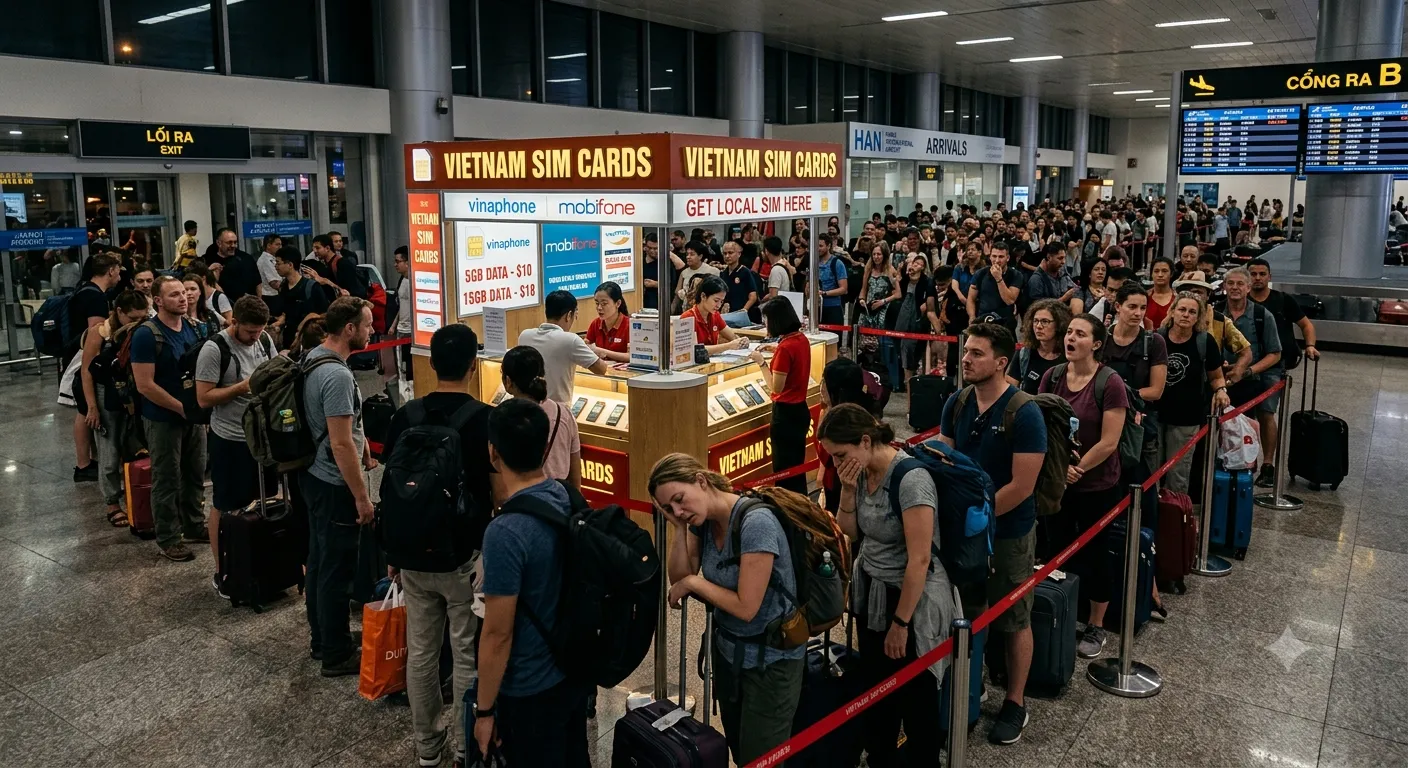
The counters exist and are legitimate for some sellers, but the seller’s status is often unclear. Hanoi Noi Bai, Ho Chi Minh City Tan Son Nhat and Da Nang all have SIM sellers.
- Official fact (Da Nang): the airport’s own page lists seven SIM counters in the restricted arrivals area of Terminal 2, near baggage claim, with Terminal 1 having its own SIM and pocket Wi-Fi counters.
- Reported at Hanoi: generic “Taxi and SIM” stalls selling pre-activated cards that risk deactivation. Several guides advise walking past.
- Reported at Ho Chi Minh City: many kiosks are resellers in carrier-branded uniforms, and a 2026 traveller says staff pushed MobiFone when Viettel was asked for. Reddit warns that some airport SIMs are not registered to the buyer.
- Process, per guides: passport photographed or scanned, sometimes a selfie, roughly 5 to 15 minutes, cash in dong the fastest. We list these as reported and not observed.
None of this means every counter is a trap. It means buying jet-lagged, with cash, from a seller you cannot verify, is a poor way to judge a mobile package. For the detail, see our Vietnam airport SIM guide: prices, scams and the registration law, and the airport-by-airport guides for Noi Bai, Tan Son Nhat and Da Nang.
Calls, SMS and a Vietnamese number
Many travel eSIMs are data-only, and “no calls” is normal. A data-only eSIM cannot receive ordinary SMS, including many verification codes. How the options compare:
- Our Viettel eSIM: data only.
- Our MobiFone eSIMs (5 and 10 days): a real +84 number that receives calls and SMS for free but cannot make outgoing calls or texts.
- Our MobiFone 11-day eSIM: 40 minutes of outbound local calls, plus free inbound calls and SMS. No full subscriber number.
- A physical SIM: a full Vietnamese number with calls and SMS, once it is registered and topped up.
If you need to ring a restaurant or a driver, or you rely on ride-hailing and delivery apps with a local number, a numbered eSIM or a physical SIM suits you better than a data-only plan. A few banks and services also apply their own country or anti-fraud rules to a Vietnamese number, so test the one you depend on.
”Unlimited” does not mean the same everywhere
Compare the high-speed allowance, what happens after it, and the validity. On our Vietnam plans, data stops once the high-speed allowance is used. There is no low-speed fallback. For the 5GB-a-day Viettel plans, that means data stops until the daily reset at 23:59 Vietnam time (GMT+7). For the MobiFone bundles, it stops when the overall allowance is used. We never describe these as unlimited or throttled.
Physical-SIM packages can differ again, and travellers report airport SIMs showing fewer days of validity than they expected. Read what the package actually includes before you pay.
Which should you choose?
- Modern unlocked phone, short trip, want to land connected: an eSIM, installed before you fly. See the Vietnam eSIM plans.
- You need a Vietnamese number that can call out, or you are staying for months and want to top up locally: a physical SIM from an official store, with your passport.
- Your phone has no eSIM support, or is carrier-locked: a physical SIM.
- You carry two phones, or want a backup: a physical SIM works in the second phone, and an eSIM can run on the main one.
- You are landing at 2 a.m. and nothing is reliable: an eSIM installed before the flight avoids depending on a counter being open. Reported hours differ between guides, so we would not rely on a late-night counter.
How we checked this
We built this from operator pages, regulation, traveller reports and our own catalog, and we label each by type.
- Official: Viettel’s tourist SIM and eSIM pages for the registration process and documents; the Viettel notice on face re-verification effective 15 June 2026; the Da Nang airport page for its SIM counters; MobiFone’s announcements on its tourist eSIM programme.
- Regulation: Decree 163/2024/ND-CP on subscriber registration, in force 24 December 2024.
- User reports: Tripadvisor and Reddit threads, and travel guides, for airport prices and seller behaviour.
- Our own catalog: eSIM prices, allowances, reset time, numbers and calling.
- Related reading: our Viettel eSIM tourist guide, complete Vietnam SIM guide and eSIM not working in Vietnam.
What we couldn’t verify
- Airport counter hours and prices. Guides disagree on hours (Da Nang is reported as 06:00 to 02:00 in one guide and 09:00 to 02:00 in another), and we have no dated price board or receipt for each airport.
- Which airport sellers are official operators. We have reports, not a counter census.
- The scope of the 15 June 2026 face-check rule for visitors. We read the notice’s headline and its framing around changing phones. We could not confirm how it applies to a tourist SIM.
- Whether Viettel’s own tourist eSIM only completes activation after arrival. One indexed Viettel page reportedly says so, but we could not re-fetch it. Our own eSIM activates automatically on connecting.
- A “30 to 50% more at the airport” figure. It is repeated by guides without a primary source.
The bottom line
If your phone supports it, an eSIM installed before you fly avoids the counter, the queue and the passport hand-over, and it keeps your home SIM active. A physical SIM from an official store is the right choice if you need a numbered line that can call out, a long stay, or a phone without eSIM. The thing to avoid is the middle option: a SIM from a booth you cannot verify, with no clear registration.
Want a Vietnam eSIM that activates on its own and needs nothing from you at the airport? See the Vietnam eSIM plans.
Frequently asked questions
Is an eSIM better than a physical SIM in Vietnam? +
For most travellers with a modern unlocked phone, yes: you install it before you fly, keep your home SIM active and land connected, with no counter, queue or passport hand-over. A physical SIM is better if your phone has no eSIM support, if you want a numbered Vietnamese line that can call out, or if you are staying for months and want to top up locally.
Do eSIMs use the same network as physical SIMs in Vietnam? +
If both come from the same operator (Viettel, MobiFone or VinaPhone), yes. An eSIM is a different way of delivering a subscription, not a different radio network. What changes the experience is which network your eSIM uses and whether it is a local Vietnamese profile or an international eSIM that roams.
Do I need my passport to buy a physical SIM in Vietnam? +
Yes. Vietnam requires subscriber registration for a physical SIM under Decree 163/2024/ND-CP, and a foreign visitor registers with an original passport. Viettel's tourist process also asks for a photo of the passport, a live face photo and an email address. Our eSIM needs none of this from you: the line is pre-registered by our supplier before you buy.
Can a Vietnam eSIM give me a Vietnamese phone number? +
Some can. Our Viettel eSIM is data-only. Our MobiFone eSIMs carry a real +84 number that receives calls and SMS for free (the 5- and 10-day plans), and the 11-day plan adds 40 minutes of outbound local calls. Many international travel eSIMs are data-only. If a local number matters for ride-hailing, delivery or one-time codes, choose a numbered plan or a physical SIM.
Is a physical SIM cheaper than an eSIM in Vietnam? +
Sometimes, from the right seller. One Tripadvisor traveller reported paying 400,000 VND for a 30-day Viettel package at an airport booth versus 180,000 VND at an actual Viettel store. Prices at airports vary widely, and guides commonly say airports cost more than city shops. Our Viettel eSIM costs $9.90 for 7 days, $14.90 for 15 days and $19.90 for 30 days.
Can I buy a SIM card at the airport in Vietnam? +
Yes. Hanoi Noi Bai, Ho Chi Minh City Tan Son Nhat and Da Nang all have SIM counters in the arrivals hall. Da Nang's own airport page lists seven SIM counters in the restricted arrivals area of Terminal 2. Travellers report that not every seller is an official operator, so check the shop's identity and that the SIM is registered in your name.
Is it a problem if an airport SIM is registered to someone else? +
It can be. Vietnam enforces subscriber registration, and travellers on Reddit report airport SIMs that turned out to be registered to another person's identity. A line registered to someone else can be blocked, and it leaves you without a recoverable account. See our airport SIM guide for what to ask at the counter.
Does 'unlimited' mean the same on every Vietnam eSIM? +
No. Many Vietnam plans give a high-speed allowance and then stop or slow down. On our Vietnam plans, data stops once the high-speed allowance is used: there is no throttled low-speed fallback. For the 5GB-a-day Viettel plans, data stops until the daily reset at 23:59 Vietnam time. Check the allowance, the speed after it and the validity before you compare prices.
What if my phone doesn't support eSIM? +
Then a physical SIM is your only option. An eSIM also needs an unlocked phone, and some iPhone models sold in mainland China, Hong Kong and Macao do not support eSIM. Check Settings or ask your carrier before you buy.
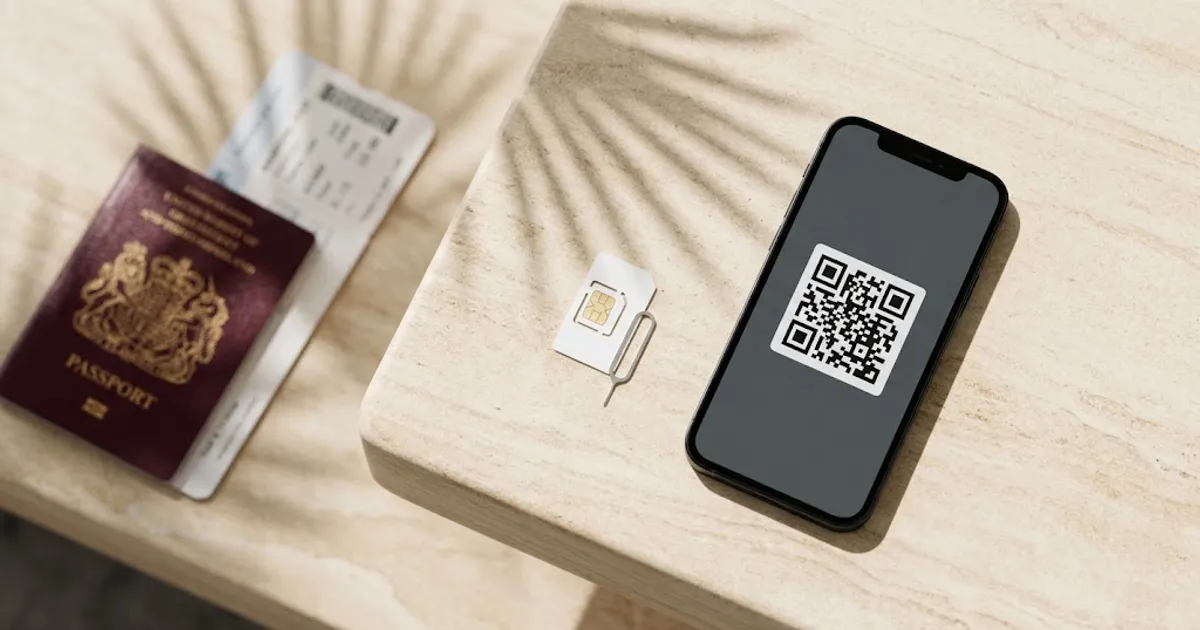
Can I install a Vietnam eSIM before I fly? +
Yes, and it is the main advantage. Install it at home, keep it off or on as your provider advises, and it connects when the phone registers on a Vietnamese network. Our Viettel eSIM activates automatically on connecting. Our MobiFone eSIMs need a one-time dial of 900 after you land, so they are not active before landing.
Get connected for your trip
Vietnam
Vietnam · 7 days · 35GB
35GB total (5GB/day)
- 5GB high-speed data per day
- Automatic activation
Automatic. Data works the moment the eSIM connects to Viettel. Nothing to dial, nothing to switch on.
QR emailed within minutes · Stripe secure checkout · No account needed
Vietnam
Vietnam · 15 days · 75GB
75GB total (5GB/day)
- 5GB high-speed data per day
- Automatic activation
Automatic. Data works the moment the eSIM connects to Viettel. Nothing to dial, nothing to switch on.
QR emailed within minutes · Stripe secure checkout · No account needed
Vietnam
Vietnam · 30 days · 150GB
150GB total (5GB/day)
- 5GB high-speed data per day
- Automatic activation
Automatic. Data works the moment the eSIM connects to Viettel. Nothing to dial, nothing to switch on.
QR emailed within minutes · Stripe secure checkout · No account needed