Vietnam SIM Registration for Tourists: What the Law Requires
Published

Short answer: Vietnam’s Decree 163/2024/ND-CP lets a tourist register a mobile SIM on a passport alone, but what carriers ask for on top of that varies: Viettel wants a live photo and selfie every time, MobiFone’s pre-arrival channel can run on just your passport and e-visa number. The catch isn’t the passport. It’s that the obligation doesn’t stop at the counter: change phones later in your trip and a separate 2026 rule gives you two hours to re-verify your face or your line starts shutting down.
Everything below comes from the decree itself (checked against the government’s own gazette PDF, not a secondhand summary), Viettel’s and MobiFone’s official pages, and the Ministry of Science and Technology’s published guidance, all read 10 November 2026. We sell a Viettel-network eSIM pre-registered upstream by our supplier, which is why the comparison with the official counter process shows up near the end.
What Decree 163/2024/ND-CP actually asks of a foreign tourist
Article 17(1)(b) of the decree names exactly one document for a foreign national registering an H2H mobile number: a passport valid under your entry visa or your visa-exempt permitted stay, or an electronic identification account as an alternative. That’s the full requirement for the document itself. The Vietnamese wording ties the passport’s validity to your visa or permitted-stay window, not to the passport’s own expiry date, so a passport valid for years but a visa valid for weeks only covers you for those weeks.
We read this straight from the government’s own Công Báo gazette PDF (Nos. 31+32, 9 January 2025, printed page 18), not a secondary site, because the clause matters enough to get right. Article 19 of the same decree lists “personal identification number or passport number” among the data fields a carrier must record, which is the decree treating a passport as an ordinary, expected input rather than an edge case.
Two things this clause does not do, worth being precise about:
- It’s a documents-to-present rule, not an identity-verification exemption. Article 18 separately requires the carrier to authenticate what you hand over, and Article 20 blocks service until both registration and authentication are complete.
- It doesn’t say your SIM switches off automatically the day your visa expires, and it doesn’t exempt you from the face re-verification rule covered below. Neither is stated in the decree; don’t assume either.
Vietnamese citizens go through a parallel but different check: Article 18 requires matching their ID against the National Population Database. That database doesn’t hold foreigners, so your information gets checked differently. Here’s where the two tracks actually diverge.
How does a foreigner’s information actually get checked?
The Ministry of Science and Technology states plainly that foreigners’ subscriber data is checked against the National Immigration Database, not the National Population Database used for citizens. That’s from the Ministry’s own guidance page, dated 3 April 2026, which addresses foreign visitors directly rather than leaving the question to inference.
This matters because it tells you the registration isn’t being waved through. Your passport and visa details get cross-checked against Vietnam’s own immigration records, which is also presumably why the visa-linked validity wording in Article 17(1)(b) exists in the first place: the system is built to know when your permitted stay ends.
Viettel’s official process: a live photo and a selfie, no file uploads
Buy a Viettel tourist SIM or eSIM and you’ll complete a five-step self-registration on top of the passport requirement: scan a QR code, take a live photo of your passport and a live selfie, review and agree to the data-protection terms, confirm, and e-sign. Viettel’s own tourist eSIM guide spells out all five steps, and it’s specific about one detail that trips people up: file uploads aren’t accepted. The photo and the selfie have to be taken live, in the moment, through the registration interface itself.
The required document is stricter than “bring your passport”:
- Original passport only. Not a photo, not a photocopy, not a driver’s license. Viettel’s guide states this directly.
- An unlocked, eSIM-compatible phone, if you’re buying the eSIM option. Check Settings > Cellular (or Mobile Data) for an “Add eSIM” option before you travel.
- An email address, specifically for eSIM orders, so the system can send your order confirmation.
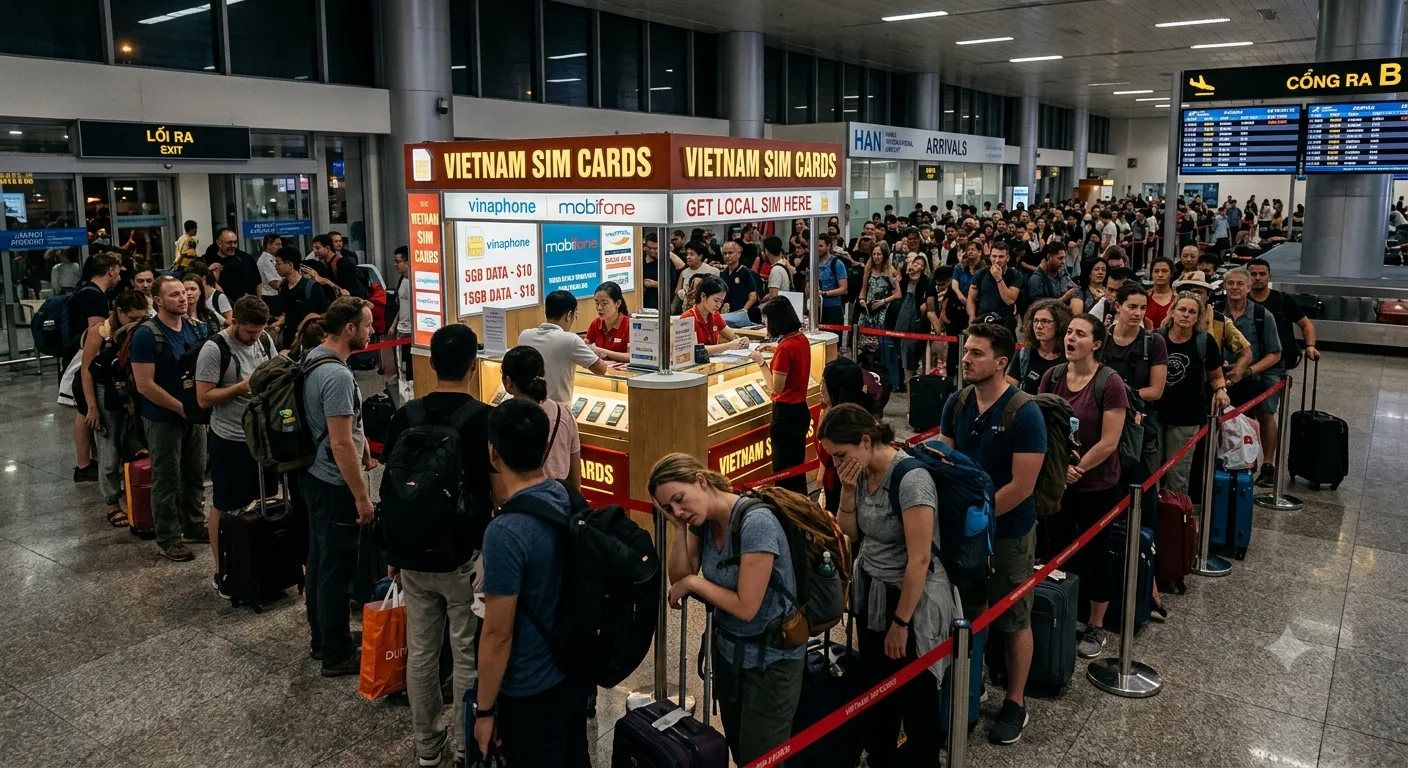
Viettel sells the tourist packages at airport kiosks in the international arrivals halls of Hanoi Noi Bai (Terminal 2), Ho Chi Minh City Tan Son Nhat, Da Nang, and smaller counters at Cam Ranh and Phu Quoc, as well as city Viettel stores and authorized points of sale. The 30-day plans run from 120,000 to 180,000 VND depending on data and call allowance, on top of the SIM itself.
One detail worth naming rather than smoothing over: Viettel’s own tourist guide cites Decree 49/2017/ND-CP, an older regulation, as its legal basis for SIM registration. Every article number and specific rule on this page comes from the newer Decree 163/2024/ND-CP instead, which is what governs the detail of what’s required today.
We tried the online portal ourselves. It didn’t work.
Viettel’s own tourist.viettel.vn portal hung indefinitely on us: we uploaded a passport photo, a live portrait, and an email at step 1 of 4 on 10 November 2026, and it never reached step 2. This is one attempt on one day, not a claim the portal always fails. But it’s a real enough gap between “five steps, minutes to complete” on the official guide and what actually happened on screen that it’s worth knowing before you count on finishing registration online rather than at a staffed counter.
If the online flow stalls for you too, the kiosk staff at the airport or in-store can walk you through the same five steps in person, which is the path Viettel’s own guide treats as the fallback.
MobiFone’s free eSIM: a lighter registration path, with a catch
MobiFone runs a genuinely free tourist eSIM program, 10GB of data for 24 hours, one per passport, and its registration can be lighter than Viettel’s: no live selfie required if you use the pre-arrival channel. That’s a real, material difference worth knowing about before you commit to one carrier over the other, and it comes straight from MobiFone’s own travel eSIM page and its published FAQ, both read 10 November 2026.
MobiFone offers two separate registration channels, and which one you pick changes what you hand over:
- E-visa channel (pre-arrival). Register online at mobifone.vn/travel before you fly, using your email address, passport number, and e-visa application number. Land, dial 900 to activate, and your full 10GB/24h package is ready immediately. No live photo is mentioned anywhere in MobiFone’s description of this path.
- Direct channel (at the airport). Scan a QR code from MobiFone posters or leaflets in the international arrivals area, then take a photo of your passport and complete a short online verification on-site. This is the path that does ask for a passport image, and our own screenshots of the flow show a “Complete Verification” step asking for both a passport photo and a portrait photo.
We went through MobiFone’s registration ourselves on 10 November 2026, and unlike the Viettel portal above, it worked. Providing just an email address and phone number was enough to get a QR code emailed within minutes, headed “eSIM Travel Registration Result” with the activation QR, the provisioned phone number, and instructions to activate only after landing in Vietnam, then call 900. The email itself still flags, in red text, that this initial step alone isn’t the end of it: “Please register your information HERE to enjoy the full 10GB data/24h benefit”, confirming MobiFone’s FAQ almost word for word. Get the QR quickly, then do the fuller passport or e-visa registration separately to actually unlock the full allowance.
Skip registration entirely and MobiFone doesn’t just quietly limit you. Dial 900 without having registered and you get a temporary data allowance only. Once that runs out, MobiFone’s own FAQ says standard internet access pauses, leaving you able to reach only mobifone.vn/travel to finish registering. Let 24 hours pass from your activation call with registration still incomplete, and the FAQ states the whole eSIM subscription gets temporarily suspended, unlocking automatically the moment you complete registration.
Two details that matter in practice and that nothing else we checked mentions:
- The eSIM profile itself is valid for 90 days from issuance, well beyond the 24-hour data window. The free data resets at 24 hours; the SIM profile doesn’t expire for three months, which matters if you’re buying before a trip that’s still weeks away.
- It’s data-only unless you pay for more. MobiFone’s free package doesn’t include calls or SMS. Local voice minutes come bundled only with its paid top-up packages: FR10 (150,000 VND, 50GB plus 70 minutes of domestic calls, valid 10 days) and FR30 (250,000 VND, 150GB plus 200 minutes, valid 30 days), payable by mobile account balance or international card (Visa, Mastercard, JCB, American Express).
MobiFone’s FAQ page doesn’t cite a decree number for any of this, so we can’t tell you whether it leans on Decree 163/2024/ND-CP, the older Decree 49/2017/ND-CP that Viettel’s guide cites, or both. What we can say with confidence is that the underlying legal registration requirement is the same one covered earlier on this page, whichever document MobiFone’s own marketing happens to reference.
Changing phones later? You get two hours
Move your SIM into a new phone and Vietnamese rule now requires face re-verification within two hours, under Circular 08/2026/TT-BKHCN, effective 15 June 2026. This isn’t specific to tourists. It applies to every subscriber, foreign or Vietnamese, the moment a SIM moves to a different device.
You clear it one of two ways: a live face capture matched against the National Population Database, the Citizen ID Database, the National Immigration Database, or encrypted data on a police-issued citizen ID chip; or a live face capture matched against the carrier’s own stored biometric data from your original registration. For a tourist without a Vietnamese citizen ID, the immigration-database or carrier-stored-biometric routes are the ones that apply.
Miss the window and the consequences escalate on a fixed clock, per Viettel’s own notice:
| Time after device change | What happens |
|---|---|
| 2 hours, verification incomplete | One-way suspension: no outgoing calls or SMS |
| +30 days from suspension | Two-way suspension: the line stops working entirely |
| +5 more days | Contract terminated, number recalled |
Viettel recommends installing the My Viettel app for a fast, free verification, but the notice addresses that specific recommendation “especially” to Vietnamese citizens. We read that as a hint that a tourist is more likely to go through the database-match route than the app, though Viettel’s notice doesn’t spell out a separate tourist path explicitly.
What it actually costs to get this wrong
The Ministry of Science and Technology cites a fine of up to 500,000 VND for an individual caught using a SIM not registered to them, and up to 200 million VND plus a seven-month ban on signing up new subscribers for a carrier that lets it happen, under Decree 174/2026/ND-CP. Those are the Ministry’s own published figures, from an August 2026 announcement about its nationwide subscriber clean-up.
What we did not find, anywhere in the sources we checked: a separate fine amount for tourists, a different grace period for visitors, or a blanket exemption from any of the above because you’re on a visa rather than a Vietnamese ID. The Ministry’s guidance addresses foreigners directly on the registration and verification side (the immigration-database check above), but it doesn’t carve out a different penalty track. Assume the ordinary consequences apply to you too, rather than assuming tourist status buys you slack it doesn’t mention.
Buying direct versus a pre-registered eSIM
Everything above is what buying directly from Viettel’s own tourist channel involves. It’s not what you go through with our eSIMs, because the subscriber-registration obligation is met upstream, by our supplier, before you ever see the QR code.
That’s not a workaround of the law. It’s a different point in the process: someone has to register the line to a real person, and on our product that happens before the SIM is issued to us rather than at the moment you buy it. You still get a genuine local Viettel profile, not a roaming guest line. The trade-off runs the other way for the two-hour face re-verification rule above: that one applies to the line itself once it’s active on a device, regardless of who originally registered it, so it’s worth reading that section even if you skip the counter process entirely.
If you’d rather skip the passport photo and the live selfie, see our Vietnam eSIM plans or the Viettel tourist eSIM guide for the pre-registered option, or compare Vietnam eSIM against a physical SIM if you’re deciding between the two approaches. For the wider landscape of airport SIM buying, including where the scams tend to happen, we’ve also written a Vietnam airport SIM guide.
What this page doesn’t cover
Viettel and MobiFone, Vietnam’s two largest carriers, are both covered here against their own official pages. VinaPhone’s tourist registration flow isn’t included; the legal obligation in Decree 163/2024/ND-CP applies to it the same as the other two, but its specific steps haven’t been checked for this page. If you’re buying from VinaPhone directly, check its own pages for the current process before you travel.
Frequently asked questions
Do tourists need a passport to register a SIM in Vietnam? +
Yes, and it's enough on its own. Decree 163/2024/ND-CP, Article 17(1)(b), lets a foreign national register using a passport valid under their entry visa or visa-exempt permitted stay, with an electronic identification account listed as the only alternative. No second document is required alongside it.
Can I register a Vietnam SIM online before I land? +
The decree allows online registration for the first three numbers per document, but Viettel's own tourist eSIM process still asks for a live passport photo and a live selfie at the point of purchase, which in practice means completing it once you're in the country with the physical SIM or eSIM in hand.
What happens if I don't re-verify my face after changing phones? +
Viettel's notice (effective 15 June 2026, under Circular 08/2026/TT-BKHCN) gives you 2 hours after moving a SIM to a new device. Miss it and you get one-way suspension (no outgoing calls or SMS), then two-way suspension after 30 more days, then contract termination 5 days after that.
Are there real fines for an unregistered SIM in Vietnam? +
The Ministry of Science and Technology cites a fine of up to 500,000 VND for an individual using a SIM not registered to them, and up to 200 million VND plus a 7-month new-signup ban for a carrier that lets it happen (Decree 174/2026/ND-CP). We found no separate tourist-specific fine or exemption stated anywhere.
Does the registration law apply to eSIMs as well as physical SIMs? +
Yes. Decree 163/2024/ND-CP covers terrestrial mobile subscriber numbers regardless of form factor, and Viettel's own tourist guide applies the same passport-and-eKYC process to its eSIM packages as to physical SIMs.
Is MobiFone's tourist eSIM registration different from Viettel's? +
Yes. MobiFone's pre-arrival e-visa channel only asks for your email, passport number and e-visa application number, no live selfie. Its at-airport channel does ask for a passport photo and a short verification step, closer to Viettel's process, which requires a live passport photo and selfie on every registration.
Is there a free tourist eSIM in Vietnam? +
MobiFone offers one: 10GB of data for 24 hours, free, one per passport. The eSIM profile itself stays valid for 90 days from issuance even though the free data resets at 24 hours, and it's data-only unless you buy a paid top-up package with call minutes included.
Get connected for your trip
Vietnam
Vietnam · 7 days · 35GB
35GB total (5GB/day)
- 5GB high-speed data per day
- Automatic activation
Automatic. Data works the moment the eSIM connects to Viettel. Nothing to dial, nothing to switch on.
QR emailed within minutes · Stripe secure checkout · No account needed
Vietnam
Vietnam · 15 days · 75GB
75GB total (5GB/day)
- 5GB high-speed data per day
- Automatic activation
Automatic. Data works the moment the eSIM connects to Viettel. Nothing to dial, nothing to switch on.
QR emailed within minutes · Stripe secure checkout · No account needed
Vietnam
Vietnam · 30 days · 150GB
150GB total (5GB/day)
- 5GB high-speed data per day
- Automatic activation
Automatic. Data works the moment the eSIM connects to Viettel. Nothing to dial, nothing to switch on.
QR emailed within minutes · Stripe secure checkout · No account needed