Vietnam Travel Apps: What Actually Works for Tourists in 2026
Published
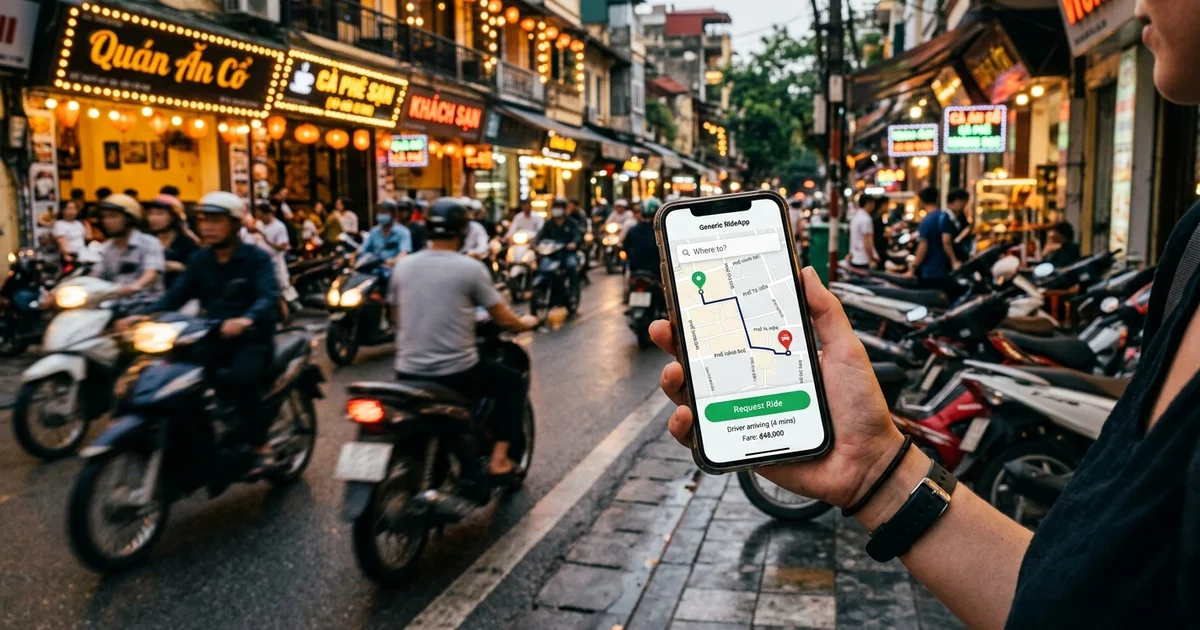
The short version: install Grab and Xanh SM for rides, keep cash as a backup for both. Skip MoMo and ZaloPay. They’ve tightened their rules for foreign visitors and most tourists won’t get past verification. Google Maps is fine for cities; add an offline map (Organic Maps or downloaded Google Maps areas) if you’re doing the Ha Giang Loop or another remote route. Zalo is optional but useful for dealing with drivers and small local businesses.
A lot of “best apps for Vietnam” lists online are a few years out of date, and in this space that matters: Gojek is gone, MoMo’s rules for foreigners changed, and a new EV ride-hailing app has become a real Grab competitor. Here’s what’s actually true right now, with sources.
Ride-hailing: Grab, Xanh SM, Be, and why Gojek isn’t an option anymore
Grab is the safest default. It takes an international phone number, has a full English interface, and accepts foreign Visa/Mastercard cards. One genuine gotcha: Grab’s own help centre confirms cards issued outside Vietnam carry a 4% payment fee, in effect since 18 March 2024, easy to miss until you check your trip receipt.
Xanh SM, VinFast’s electric-vehicle ride-hailing service, has grown into a real alternative, and traveller reports frequently praise the newer, cleaner cars. Pricing comparisons are mixed: some travellers report it’s cheaper than Grab, especially when Grab’s prices surge; others find it comparable. Foreign-card support is the inconsistent part: some reports describe it working, others describe failures, and at least one 2026 guide says foreign cards weren’t yet supported in Xanh SM’s in-app payment as of early that year. Carry cash as a backup either way.
Be is a genuine third option with meaningful market share, but tourist-friendliness is the weak point: partial English, and foreign-card/foreign-number support described as less reliable than Grab or Xanh SM in the reports we found. Worth installing only if the other two are expensive or unavailable on your route; pay cash.
Gojek is gone, not lingering. GoTo’s press release confirms Gojek’s Vietnam operations closed on 16 September 2024. Any current list still recommending Gojek for Vietnam hasn’t been checked recently.
Payments: why MoMo and ZaloPay probably won’t work for you
This is the part most “Vietnam apps” lists get wrong by omission: they list MoMo and ZaloPay as must-haves without mentioning that both have tightened their rules in ways that specifically affect short-term visitors.
MoMo now requires identity and biometric verification through a Vietnamese citizen ID (CCCD) or a Level 2 VNeID account, plus a linked Vietnamese bank account. A widely cited Reddit thread from October 2024 quotes MoMo’s own support confirming that, from 6 September 2024, new foreign customers could no longer authenticate using a passport alone. Further reports from early-to-mid 2025 describe the same verification wall. (Dated traveller reports, 2024–2025; MoMo’s own onboarding guidance confirms the current ID/biometric requirement.) Practical verdict: don’t rely on MoMo as a tourist.
ZaloPay. The evidence here is thinner than for MoMo, but travellers consistently describe the same pattern: useful functions tied to a Vietnamese phone number and, for actually funding the wallet, a local bank account. Treat it the same way as MoMo until proven otherwise.
VNPay QR and the VNPAY App are the one genuinely promising option here, and underreported elsewhere. VNPay’s own site describes a tourist-specific onboarding route: register with an international phone number, passport details, verify by email OTP, and link an international Visa, Mastercard, JCB or Amex card (Apple Pay too, on supported devices). That’s different from the usual assumption that VNPay-style QR codes only work inside a Vietnamese bank’s own app, though the official instructions describe the onboarding route rather than a guarantee every merchant’s QR code or every foreign card will go through. Treat it as the strongest lead to test rather than a confirmed guarantee until you’ve tried it yourself.
| Method | What the evidence shows | Verdict for a short-term tourist |
|---|---|---|
| International Visa/Mastercard | Works on Grab and most card terminals, with Grab’s 4% foreign-card fee | Carry as your primary method |
| MoMo | Requires Vietnamese ID/biometric verification + local bank account since Sept 2024 | Don’t rely on it |
| ZaloPay | Vietnamese number + local bank account generally needed | Don’t plan around it |
| VNPAY App (tourist route) | Official onboarding allows international phone + passport + international card | Worth testing, not yet confirmed end-to-end |
| Cash | Works everywhere, especially smaller businesses | Always carry some |
Maps: Google Maps is fine for cities, not for the Ha Giang Loop’s finer details
Google Maps is a sensible default in Hanoi, Ho Chi Minh City, and Da Nang. The real weak spot isn’t a Vietnam-specific failure, it’s the usual limits of any general-purpose routing app in mountainous or remote terrain. On the Ha Giang Loop, traveller accounts describe successfully using Google Maps on the main route, while separately warning that estimated travel times can be unrealistic on steep mountain roads and that smaller detours are less reliably mapped.
For that kind of trip, download the relevant area in Google Maps for offline use, and consider Organic Maps (OpenStreetMap-based, works fully offline, no account needed) as a second source, useful for rural tracks and points of interest Google sometimes misses. Google’s own help documentation confirms offline driving directions work as long as the whole route is within the downloaded area, though live traffic and alternate routes aren’t available offline.
Do you actually need Zalo?
Zalo is Vietnam’s dominant messaging app, and it shows up in traveller reports as the thing a driver, homestay host, or small tour operator will message you on instead of calling or using WhatsApp. It isn’t essential if you’re sticking to big hotels and Grab/Xanh SM for everything, but if you’re booking anything more local, installing it removes a layer of friction. Reports on foreign-number signup are mixed: some travellers register fine with a UK or other international number, others describe SMS verification issues. Test it before you rely on it for something time-sensitive.
This is built from official sources (Grab’s and VNPay’s own help pages, GoTo’s press release on the Gojek exit) cross-referenced against dated traveller reports on Reddit spanning 2024-2026, rather than our own first-hand field test. A few things are still genuinely unsettled: Xanh SM and Be’s current foreign-card behaviour gets conflicting reports and may have shifted since they were written, ZaloPay’s exact onboarding flow for a foreign passport holder is less documented than MoMo’s clear policy change, and we only found one secondary source claiming a new State Bank circular further tightens e-wallet biometric KYC from January 2026, not an official State Bank announcement, so treat that one specifically as unconfirmed. If you’ve tested any of this recently, we’d genuinely like to know what happened. Apps like these change fast, and we’d rather fix this page than leave it wrong.
Planning Vietnam data too? See our eSIM vs physical SIM comparison, how much data you actually need, the Viettel tourist eSIM guide, or what to do if your eSIM isn’t working once you land.
Frequently asked questions
Can foreigners use Grab in Vietnam? +
Yes. Grab is the most tourist-friendly app in Vietnam. It accepts foreign phone numbers and international Visa/Mastercard cards, and has a full English interface. Grab's own help centre states foreign-issued cards carry a 4% payment fee (in effect since March 2024), so check your receipt and keep cash as a backup.
Is Gojek still available in Vietnam? +
No. GoTo (Gojek's parent company) officially confirmed it shut down Gojek's Vietnam operations on 16 September 2024. Any guide still listing Gojek as a Vietnam ride option is out of date.
Can tourists use MoMo in Vietnam? +
Don't count on it. Since September 2024, MoMo tightened identity verification for new foreign users, and multiple traveller reports from 2025 describe being unable to complete passport-based verification. Full wallet use generally expects a Vietnamese bank account too.
Can foreigners use ZaloPay as a tourist? +
Evidence here is weaker than for MoMo, but the practical reports point the same way: ZaloPay's useful features are tied to a Vietnamese phone number and, for funding the wallet, a local bank account. Don't plan your trip around it.
Is there any way for a tourist to use Vietnamese QR payments? +
VNPay has published a dedicated tourist onboarding route for its VNPAY App, registering with an international phone number, passport details, email OTP, and linking an international Visa, Mastercard, JCB or Amex card (Apple Pay is mentioned too for supported devices). This is different from just scanning a QR code inside a Vietnamese bank app, which generally won't work for a foreign-issued card. We haven't tested the full flow ourselves, so treat it as the most promising lead rather than a guarantee.
Which is cheaper, Grab or Xanh SM? +
Reports go both ways: some travellers find Xanh SM cheaper, especially when Grab's prices surge; others find them about the same. It depends on the route and time of day, so it's worth checking both before you book rather than assuming one is always cheaper.
Is Google Maps reliable in Vietnam? +
Yes for cities (Hanoi, Ho Chi Minh City, Da Nang). For remote routes like the Ha Giang Loop, it's usable on the main road but its time estimates can be unrealistic on steep mountain roads, and smaller detours are less reliable, so download offline maps and don't treat the ETA as exact.
Do I need Zalo as a tourist in Vietnam? +
Not essential, but useful. It's Vietnam's dominant messaging app, and some drivers, homestays and small tour operators will message you on Zalo rather than call or use WhatsApp. If you're booking anything outside a big hotel chain, installing it removes friction.
Get connected for your trip
Vietnam
Vietnam · 7 days · 35GB
35GB total (5GB/day)
- 5GB high-speed data per day
- Automatic activation
Automatic. Data works the moment the eSIM connects to Viettel. Nothing to dial, nothing to switch on.
QR emailed within minutes · Stripe secure checkout · No account needed
Vietnam
Vietnam · 15 days · 75GB
75GB total (5GB/day)
- 5GB high-speed data per day
- Automatic activation
Automatic. Data works the moment the eSIM connects to Viettel. Nothing to dial, nothing to switch on.
QR emailed within minutes · Stripe secure checkout · No account needed
Vietnam
Vietnam · 30 days · 150GB
150GB total (5GB/day)
- 5GB high-speed data per day
- Automatic activation
Automatic. Data works the moment the eSIM connects to Viettel. Nothing to dial, nothing to switch on.
QR emailed within minutes · Stripe secure checkout · No account needed